
English| EUR
Suggested for you
More currencies
Choose a language
Haleakalā's summit road ends at 10,023 feet, above the cloud layer and close to freezing before dawn. Visitors rarely misjudge the sunrise itself; they misjudge everything wrapped around it. This page sets out where the hours actually go, from the reservation window to the drive back down.
Quick answer
Most visitors spend three to four hours on the sunrise, arriving inside the 03:00–05:00 window and leaving once the light flattens. The park itself is open 00:00–23:59 daily, so the real constraint is the reservation required for entry between 3am and 7am, not a gate time. Add the drive from the coast separately.
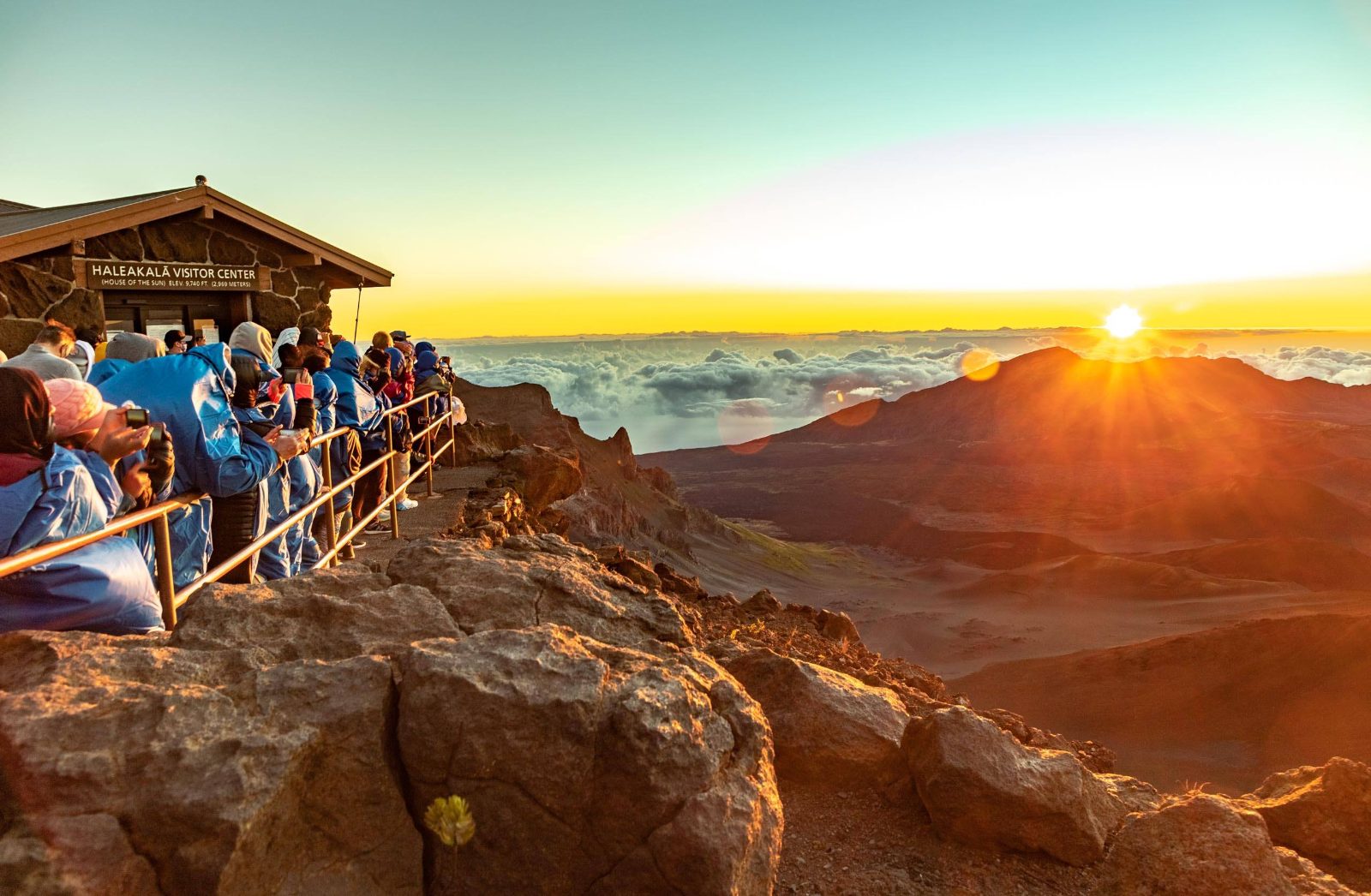
The sun clears the horizon at Puʻuʻulaʻula Summit in roughly two minutes. Almost nobody drives to 10,023 feet for two minutes. That gap is why so many visitors ask how long does haleakala sunrise take before they book anything else on Maui. The clock is set by the reservation system, not by the gate. Haleakalā National Park itself never closes, but entry between 3am and 7am requires a reservation, and park guidance points visitors toward an arrival window of 03:00–05:00. Arriving at the early edge of that window buys a parking space near the Haleakalā Visitor Center or Pā Kaʻoao; arriving late usually means parking further down and walking up in the dark. Altitude sharpens the wait. At 10,023 feet the air is thin and temperatures routinely sit near freezing. Most of the elapsed time is spent above the cloud inversion layer, watching the sky change color long before the disc appears. Haleakalā sunrise duration therefore breaks into three unequal parts: the pre-dawn wait, the sunrise itself, and the descent back through Kula. The first is the longest. The second is measured in minutes. The third is where visitors underestimate the time, because the summit empties all at once and the road down is steep, switchbacked and shared with cyclists. Guided Haleakalā sunrise tours handle this differently, extending the morning on purpose with a stop at Leleiwi Overlook, a look at the ʻāhinahina silverswords, or breakfast in Upcountry Maui. That changes the arithmetic. A self-driven trip ends sooner; an organised Maui summit sunrise tour runs longer but hands the driving back to somebody else. The practical takeaway is to treat how long does haleakala sunrise take as a block of time rather than a single number, then plan the rest of the day thin. A summit morning tends to end with a long descent and a flat afternoon; ambitious add-ons like Sliding Sands or the Pipiwai Trail are possible on paper and punishing in practice. Reservations for the 3am to 7am period are released on a rolling schedule through the National Park Service, and popular dates disappear quickly, so the booking decision usually comes before the itinerary decision. Visitors who would rather not drive Haleakalā Highway in the dark can compare guided departures from Kahului, Kīhei and Lahaina, which fold the reservation, the transport and the timing into one arrangement.
“The sunrise lasts two minutes; the morning built around it takes most of a night.”
This plan suits first-time visitors driving up for the summit sunrise and wanting to know the real time commitment: roughly five to six hours from the 03:00–05:00 arrival window to leaving the summit area. Times shift with the season, so treat the slots as a sequence rather than a fixed clock.
Pull into the Haleakalā Visitor Center lot within the 03:00–05:00 window and secure a parking space. The upper lots fill first, so allow 15–20 minutes for parking and walking to a viewpoint.
Settle at the Visitor Center wall or the Pa Ka'oao (White Hill) trail overlook, about a 10-minute uphill walk. Expect to hold your spot for an hour or more in cold wind.
Roughly 60–75 minutes of standing in the dark before first light, with stargazing overhead and no facilities beyond the Visitor Center restrooms. Bring a headlamp for moving between spots.
The sky begins colouring 45–60 minutes before the sun clears the horizon, and the cloud layer below the summit lights up first. This stretch is often better than the sunrise itself.
The disc takes about 10–15 minutes to rise fully above the crater rim. A ranger talk is often given near the Visitor Center around this time.
Spend 30–45 minutes at Kalahaku Overlook or the Pu'u'ula'ula summit building as light fills the crater. Both are short drives or walks from the Visitor Center.
Traffic leaving is heaviest in the first 30 minutes after sunrise, so either leave immediately or linger until the queue thins. Total time on the mountain: five to six hours.
The best time to experience the sunrise is during the shoulder seasons when weather conditions are generally more stable. Planning your visit within the 03:00–05:00 arrival window is essential for securing a viewing spot before the dawn light begins.
Temperatures near 40°F (4°C); clear skies.
Dry conditions offer high visibility for the sunrise event.
Temperatures near 40°F (4°C); stable air.
Fewer visitors compared to summer provide a quieter experience.
Temperatures can drop below 30°F (-1°C).
Expect colder winds and potential cloud cover at the summit.
—
Visiting midweek reduces traffic at the summit parking areas.
Verdict: The best time for a sunrise visit is on a weekday during April or October, ensuring you arrive within the 03:00–05:00 arrival window.
Haleakalā National Park is accessed via Haleakalā Highway, which climbs steadily toward the summit at 30000 Haleakalā Hwy, Kula, HI 96790. Most visitors reach the summit district by private vehicle.
Haleakalā Hwy (HI-377 to HI-378) from Kahului
Haleakalā Hwy from Wailea/Kīhei
Haleakalā Hwy from Lahaina/Kāʻanapali
To ensure access for sunrise, adhere to the best arrival window of 03:00–05:00. Note that a reservation is required for entry between 3am and 7am, and arriving early is necessary to secure parking.
Summit temperatures near freezing and a pre-dawn start mean the difference between a comfortable morning and a miserable one comes down to what you sort out in advance.
Haleakala National Park remains accessible to visitors throughout the week, operating on a 24-hour schedule to accommodate sunrise viewing. Please note that while the park is always open, specific reservations are required for entry during the early morning hours.
Entrance to Haleakala National Park is regulated by a flat fee per private vehicle. This charge covers park access for a duration of three consecutive days.
Verdict: A typical visitor arriving by private vehicle pays 30 USD, provided they have secured the required sunrise reservation.
Everything you need to know about how long does haleakala sunrise take
A typical sunrise visit usually spans three to four hours, accounting for parking, waiting for the celestial event, and observing the morning light over the volcanic crater. Understanding how long does haleakala sunrise take helps you plan your morning transit back down the mountain safely.
Yes, reservations are required for the 3am-7am window to manage vehicle capacity at the summit. Securing your entry in advance is essential for this popular Maui attraction.
When arriving at 3am, you will have several hours to secure a parking spot and acclimate to the high-altitude environment before the dawn colors appear. The question of how long does haleakala sunrise take often depends on how much time you spend hiking or exploring the visitor center afterward.
The entrance fee is 30 USD per private vehicle and remains valid for three days. This fee provides access to the entire national park area.
The official best arrival window is between 03:00 and 05:00. Arriving early ensures you can navigate the winding Haleakalā Highway without traffic delays.
The park is open 24 hours a day, seven days a week, allowing visitors to access the summit at various times. However, the specific sunrise timeframe requires a reservation.
Considering how long does haleakala sunrise take is part of a complete itinerary that includes waiting for twilight and the official moment of dawn. Most guests linger for a short time after the sun clears the horizon to witness the landscape fully illuminated.
While the astronomical event itself takes only minutes, the duration of your visit is dictated by your own pace and desire to explore the cinder cones. Planning for a half-day excursion ensures you are not rushed during your time in this volcanic wilderness.
Haleakala Sunrise Logistics & Drive Times
Read more Tickets & toursPrivate Haleakala Sunrise Tours
Read more Tickets & toursHaleakala Sunrise Tour Hotel Pickups
Read more Tickets & toursHaleakala Sunrise Bike Tours
Read more Tickets & toursHaleakala Sunrise Tours from Kaanapali
Read more GuideHaleakala Sunrise Tickets & Permits
Read more